Dictionary Of Botany by Parameshwar Hegde
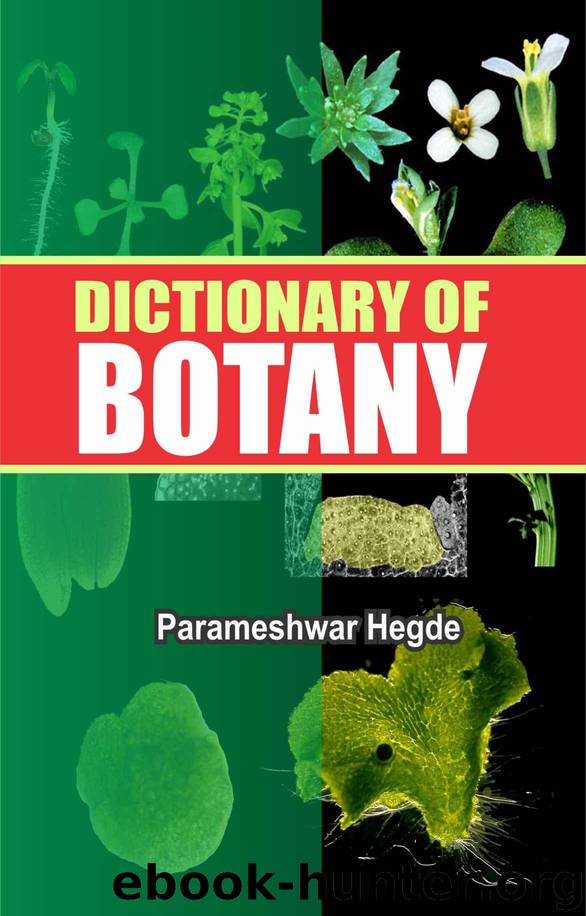
Author:Parameshwar Hegde
Language: eng
Format: azw3
Publisher: Gaurav Book Centre Pvt. Ltd.
Published: 2015-10-28T04:00:00+00:00
M
MAASTRICHTIAN AGE. The Maastrichtian age was the last part of the Cretaceous period, about 71 to 65 million years ago, at the very end of the Mesozoic Era.
MAGNETIC FIELD.
The Earth’s magnetic field is aligned with the north and south poles, and has reversed many times during geologic history. A fossil’s magnetic orientation can give clues to its date.
MALM EPOCH. The Malm epoch was the late (or upper) part of the Jurassic period, about 159 to 144 million years ago.
MANGROVE. Mangroves are tropical evergreen trees and shrubs. They live near the shore in tropical marshes and tidal shores with their adventitious roots in the salt water. Classification: genus Rhizophora. Some mangroves include the red mangrove (Rizophora mangle), the black mangrove (Avicennia germinans), and the white mangrove (Laguncularia racemosa).
MANGROVE FOREST. A mangrove forest (also called a mangrove swamp) is an expanse of mangrove trees. These trees live near the shore in tropical marshes and tidal shores with their adventitious roots in the salt water.
MARGINS. The margins of a leaf are its edges, which very from plant to plant. The margins can be smooth, serrated, or toothed; they can also be lobed or entire.
MASSARANDUBA TREE. The Massaranduba tree (Manilkara bidentata)), also called the cow tree, macaranduba, bulletwood, and balata, is a large rainforest tree whose sap is milky white and is edible. Its fruit is also edible. This tree grows to about 100 to 150 feet tall and has a diameter of 2 to 6 feet. The tree’s unusual bark is deeply-scored, reddish and ragged. The bark is used to produce a red dye. Many Massaranduba trees are in the rainforest are being harvested for its durable lumber.
MASS EXTINCTION. Mass extinction is the process in which huge numbers of species die out suddenly. The dinosaurs (and many other species) went extinct during the K-T extinction, probably because of an asteroid that hit the Earth.
MEDULLARY RAYS. Medullary rays (also called wood rays) are bundles of cells that radiate from the center of a tree like the spokes of a wheel (they are most easily seen in the cross section of a tree trunk). They store food and transport it horizontally within the tree.
MEIOSIS. Meiosis is a process in which an eukaryotic cell’s (diploid) nucleus divides twice and produces four daughter cells (called gametes or reproductive cells), each of which have half the genetic complement of the parent cell (they are haploid). This process was named by Farmer and Moore in 1905.
MERISTEM. The meristem is a group of plant cells that can divide indefinitely. The meristem provides new cells for the plant.
MESIC. Mesic environmental conditions are ones with medium moisture (water). Compare with very dry conditions (xeric) and very wet conditions (hydric).
MESIC SOIL. Mesic soil is a medium type of soil (hence the name, which means middle) that drains well yet retains some water. Mesic soil is exellent for farming.
MESOPHYLL. Mesophyll is the internal tissue of a photosynthetic leaf.
MESOPHYTE. A mesophyte is a plant that has moderate water requirements. (Compare with hydrophytes and xerophytes.)
MESOZOIC ERA.
The Mesozoic Era (“The Age of Reptiles”), occurred from 248-65 million years ago.
Download
This site does not store any files on its server. We only index and link to content provided by other sites. Please contact the content providers to delete copyright contents if any and email us, we'll remove relevant links or contents immediately.
Whiskies Galore by Ian Buxton(42154)
Introduction to Aircraft Design (Cambridge Aerospace Series) by John P. Fielding(33244)
Rewire Your Anxious Brain by Catherine M. Pittman(18795)
Craft Beer for the Homebrewer by Michael Agnew(18342)
Cat's cradle by Kurt Vonnegut(15550)
Sapiens: A Brief History of Humankind by Yuval Noah Harari(14552)
Leonardo da Vinci by Walter Isaacson(13505)
The Tidewater Tales by John Barth(12751)
Thinking, Fast and Slow by Kahneman Daniel(12526)
Underground: A Human History of the Worlds Beneath Our Feet by Will Hunt(12224)
The Radium Girls by Kate Moore(12177)
The Art of Thinking Clearly by Rolf Dobelli(10713)
Mindhunter: Inside the FBI's Elite Serial Crime Unit by John E. Douglas & Mark Olshaker(9515)
A Journey Through Charms and Defence Against the Dark Arts (Harry Potter: A Journey Throughâ¦) by Pottermore Publishing(9334)
Tools of Titans by Timothy Ferriss(8591)
Wonder by R. J. Palacio(8239)
Turbulence by E. J. Noyes(8200)
Change Your Questions, Change Your Life by Marilee Adams(7929)
Nudge - Improving Decisions about Health, Wealth, and Happiness by Thaler Sunstein(7850)
